June 20, 2026 • Declan Marsh • 10 min reading time • Prices verified June 11, 2026
The Flip-Screen Point-and-Shoot Decision: Kodak C1, FZ55, and Canon PowerShot V1 Compared
If you’ve been shopping for a small camera to carry everywhere — something you can slip into a jacket pocket or a bag without dedicating half a shelf to it — you’ve probably noticed that “point-and-shoot” now covers a surprisingly wide range. A point-and-shoot is simply a compact camera with a built-in lens and automatic exposure handling: you don’t swap lenses, you don’t spend ten minutes setting up a shot. They’re designed to get out of the way and let you take pictures. The flip screen — a rear LCD that tilts or rotates toward you — is a specific bonus that makes self-portraits, low-angle shots, and vlogging dramatically easier. Three cameras have been generating conversation in this space: the Kodak C1, the Kodak FZ55, and the Canon PowerShot V1. They share the flip-screen feature and roughly the same portable footprint. That’s where the similarity ends. This article maps their real-world trade-offs so you can make a confident decision before any money changes hands.
| EDITOR'S PICKCanon PowerShot V1 | Mid-tierKodak PIXPRO FZ55-BK 16MP CMOS… | Budget pickKodak PIXPRO C1 Digital Camera | |
|---|---|---|---|
| Sensor | — | 16MP CMOS | 13MP |
| Zoom | Ultra-wide zoom | 5X optical | 4X optical |
| Video | 4K | 1080P | 1080p |
| Screen | — | 2.7" LCD | 180° flip |
| Use case | Vlogging/streaming | Vlogging | Point & shoot |
| Price | $849.00 | $139.99 | $99.99 |
| See on Amazon → | See on Amazon → | See on Amazon → |
What You’re Actually Comparing: Three Very Different Cameras With the Same Feature
The flip screen is the entry ticket, but these three cameras are playing different games entirely.
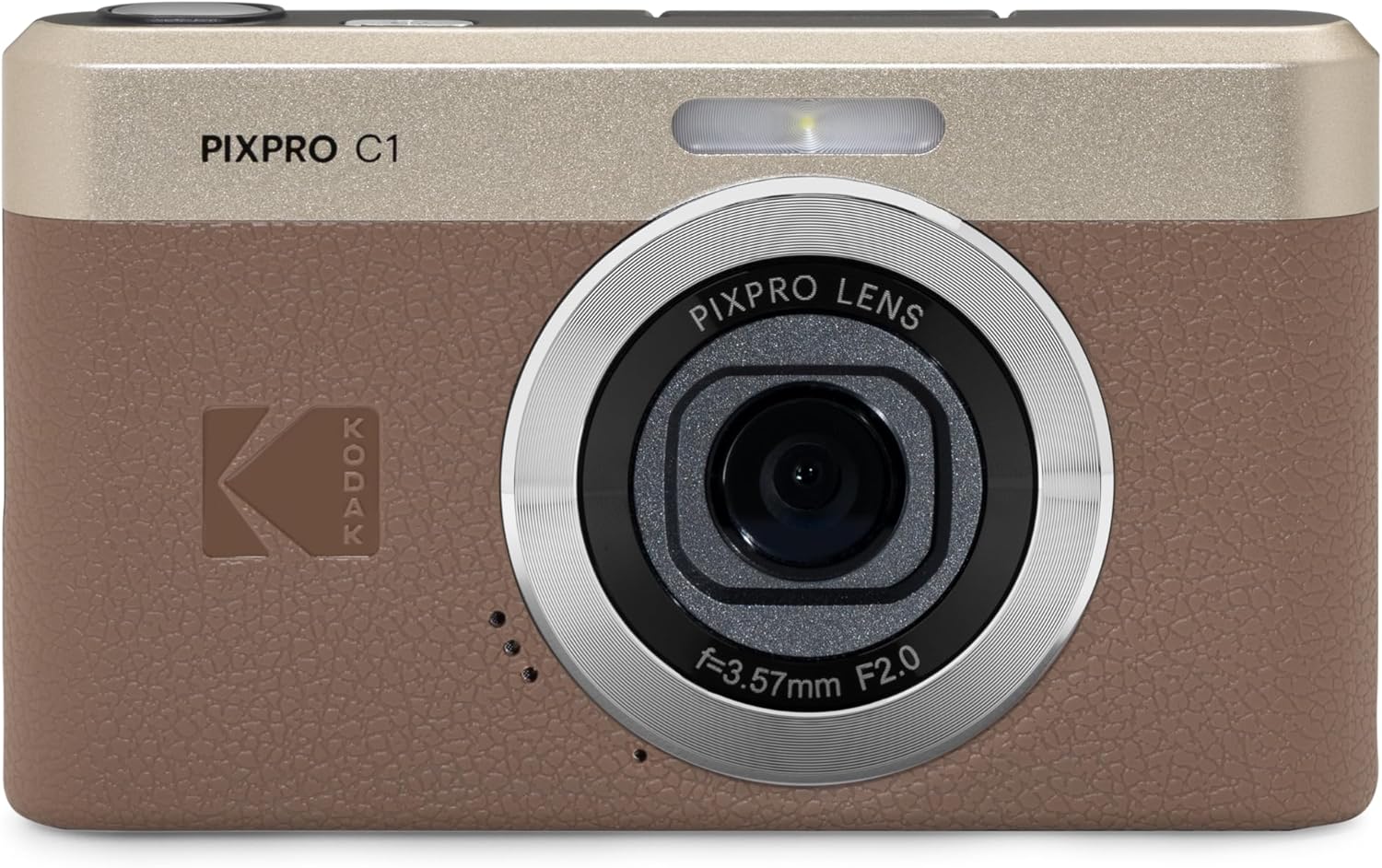
Kodak C1 — Retro Aesthetic, Deliberate Trade-Offs
The Kodak C1 is explicitly positioned as a retro-aesthetic device — think early-2000s digital camera vibes in a modern body. The Phoblographer’s compact camera coverage has noted this dual personality clearly: fans describe it as a deliberate “phone alternative” that leans hard into nostalgia as a feature, while critical reviewers are more pointed about its physical construction. The plastic build is lightweight to the point of feeling insubstantial, there’s no protective cover for the lens, and there’s no cover for the SD card slot. These aren’t nitpicks — they’re signals about the camera’s intended use case and durability expectations.
Photography Life’s point-and-shoot buying guide flags build integrity as a top durability variable for compact cameras. By that measure, the C1 sits at the lower end of the spectrum. For a buyer who wants a throwable, consequence-light device to recreate a specific aesthetic, those trade-offs are legible. For a buyer expecting a small camera they’ll rely on for years, they matter quite a bit.
Kodak
$99.99
In stock on Amazon
Check price on AmazonKodak FZ55 — The Uncomplicated Travel Compact
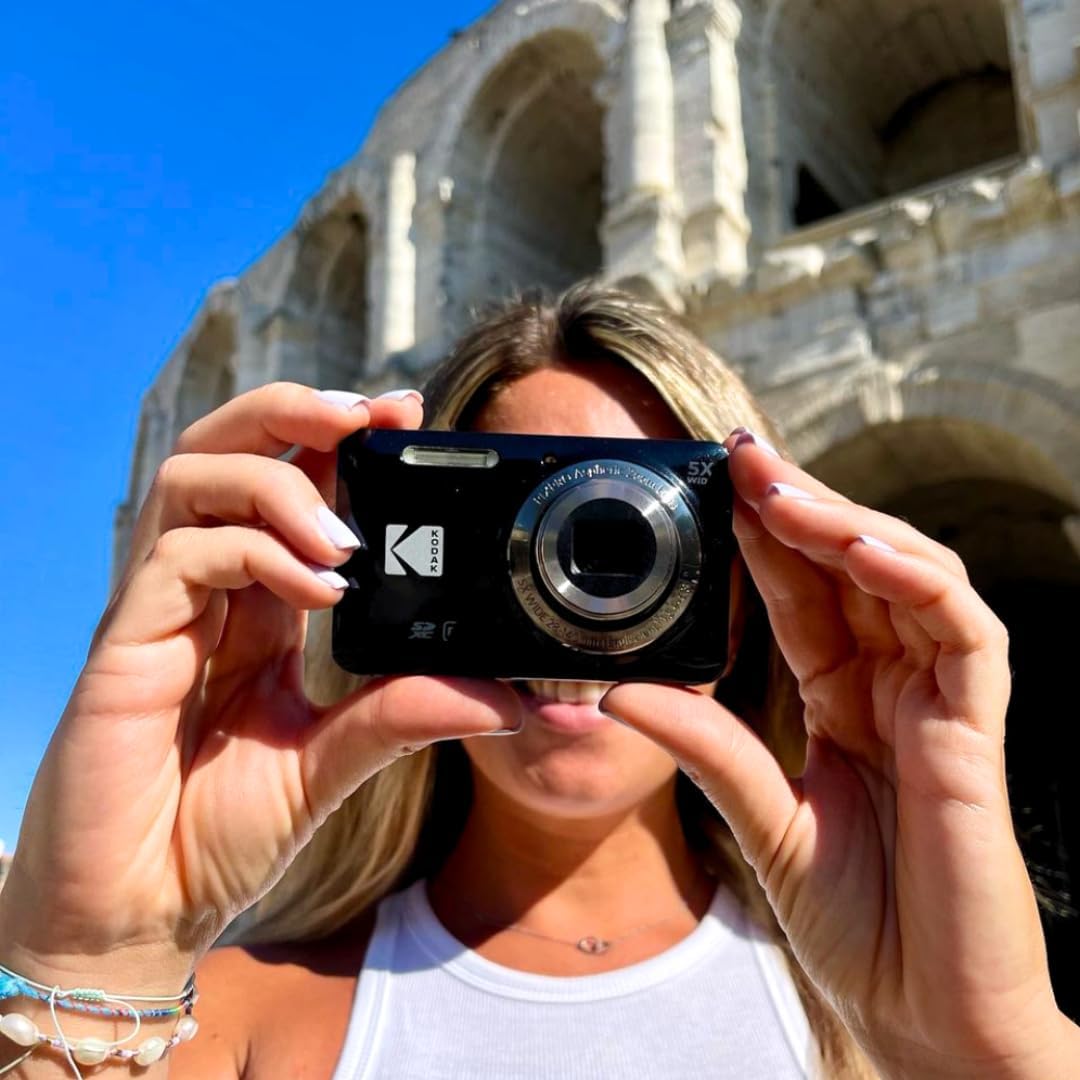
The Kodak FZ55 is a simpler proposition. It’s a travel-oriented compact that earns consistent praise in aggregated owner reviews for doing exactly what it promises: reliable auto-mode performance, compact dimensions, and strong battery life. Travel shooters who don’t want to think about settings repeatedly call out how well it handles everyday scenes in auto mode. It doesn’t try to be a creative tool or a prestige item. It tries to be dependable, and by most accounts it succeeds.
One practical ownership advantage sets the FZ55 apart from most competitors in its class: it runs on AA batteries. As noted in Photography Life’s compact camera overview, AA-compatible cameras offer meaningful flexibility for travelers, particularly in regions where proprietary battery chargers are inconvenient to source. NiMH rechargeable AAs are fully compatible with the FZ55, which addresses the most common concern buyers raise about AA-powered cameras. Keep a spare charged set and the battery question mostly disappears.
Kodak
$139.99
In stock on Amazon
Check price on AmazonCanon PowerShot V1 — Larger Sensor, Fixed Ultrawide, Higher Ambition
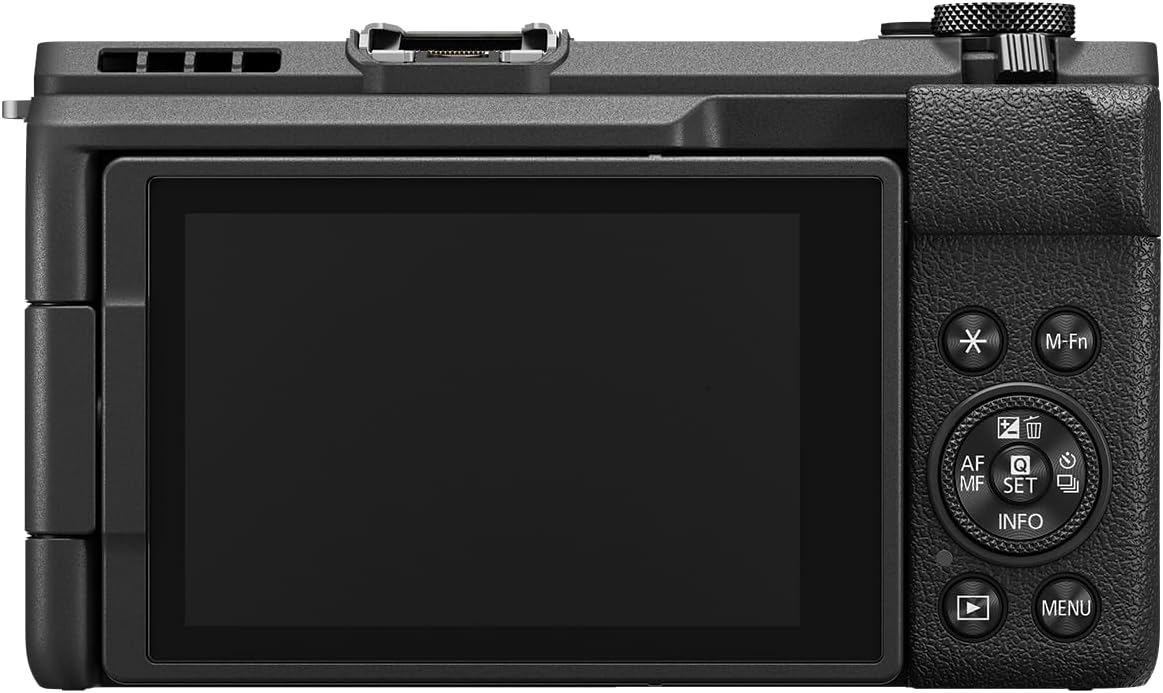
The Canon PowerShot V1 occupies a clearly higher tier. Based on specifications and hands-on coverage published by DPReview and Petapixel, the V1 is built around a 1-inch sensor — a larger imaging surface than the typical compact camera sensor — paired with a fixed ultrawide lens. Petapixel’s hands-on preview coverage noted the V1’s positioning as a serious carry-everywhere compact for photographers who want meaningful image quality without mirrorless bulk.
Pop Photo’s compact camera coverage has consistently observed that fixed-lens compacts at this sensor size tend to reward shooters who develop intentionality about positioning — and penalize those who rely on zoom as a compositional shortcut. That tension is the key to knowing whether the V1 belongs in your bag.
Canon
$849.00
In stock on Amazon
Check price on AmazonThe Optical Zoom Question — and Why It’s a Dealbreaker for Some Buyers
This is the issue that generates the most confusion in Kodak C1 reviews, and it’s worth addressing directly before anything else.
The Kodak C1 has no optical zoom — only digital zoom. This is not a minor spec footnote. Optical zoom physically moves the lens elements to magnify a scene, preserving image quality. Digital zoom is software cropping: it enlarges the image by discarding pixels, which degrades quality noticeably. On a camera with the C1’s sensor size, digital zoom quickly produces results that are softer and noisier than simply cropping a full-resolution image later on your phone or computer. If you’ve ever pinched to zoom on an older smartphone and noticed the image go grainy and soft, you’ve experienced digital zoom. The C1 has that, and only that.
For buyers who understood this going in — particularly those drawn to the retro aesthetic and the fixed-wide-angle look — this is fine. For buyers who assumed “it’s a camera, it must zoom like cameras do,” it’s a source of genuine disappointment that shows up repeatedly in critical reviews. Know this before you commit.
The FZ55 includes genuine optical zoom, which is a meaningful differentiator over the C1 for anyone who photographs subjects at varying distances. The Canon PowerShot V1 takes the opposite philosophy entirely: it’s a fixed-lens camera, meaning there is no zoom at all. You zoom with your feet. This is a deliberate design choice shared by serious fixed-lens compacts going back to the Ricoh GR and Fujifilm X100 series, and it’s one that rewards a certain shooting style while frustrating another.
The Phoblographer’s analysis of the compact camera market has noted this distinction repeatedly: fixed-lens cameras at the premium tier are tools for photographers who have internalized a preferred focal length, not cameras for buyers who want flexibility above all else.
Canon PowerShot V1 vs. G7X Mark III: The Comparison That Actually Matters
The G7X Mark III is the camera the V1 gets compared to most often, and the comparison is instructive precisely because it’s imperfect.
The G7X Mark III is a zoom compact — it covers a range of focal lengths from a moderate wide to a mild telephoto. It’s flexible, capable in low light, and popular with vloggers who need coverage of different scene sizes from a single small camera. The V1 shares the vlogging-friendly design language and the 1-inch sensor tier, but it replaces the zoom with a fixed ultrawide lens. According to DPReview’s PowerShot V1 specification coverage, the V1’s lens focal length is wider than the G7X Mark III’s starting position — useful for environmental shots, small-space vlogging, architecture, and street photography, less useful for isolating a subject at distance or compressing a background for portraits.
Petapixel’s V1 preview coverage observed that the ultrawide is simultaneously the camera’s most compelling feature and its most significant constraint. For a photojournalist, documentary shooter, or vlogger who works in tight spaces and wants consistent framing without fussing over focal-length choice, the V1 is arguably the better-designed tool. For a travel shooter who wants flexibility across landscapes, portraits, and street scenes, the G7X Mark III’s zoom still makes more practical sense.
Pop Photo’s compact camera market roundup for 2025–2026 reinforces this framing: the V1 is not a universal upgrade from the G7X Mark III — it’s a lateral move toward a more opinionated, higher-image-quality tool for a more specific shooting style.
Specification Comparison
| Feature | Kodak C1 | Kodak FZ55 | Canon PowerShot V1 |
|---|---|---|---|
| Sensor Size | Small (compact) | Small (compact) | 1-inch |
| Optical Zoom | None (digital only) | Yes | Fixed lens (no zoom) |
| Flip Screen | Yes | Yes | Yes |
| Memory Card | microSD | Standard SD | Standard SD |
| Battery Type | Proprietary | AA (rechargeable compatible) | Proprietary |
Build Quality and Practical Durability
The C1’s build quality criticism from reviewers — the absence of lens and card slot covers specifically — is worth taking seriously if you’re imagining this camera living in a bag with keys, chargers, and other debris. A lens without a cover accumulates scratches. A card slot without a cover is a dust and debris entry point. Neither is catastrophic, but they indicate the tolerance level the camera was designed for.
Photography Life’s compact camera buying guide framework specifically flags lens protection as a durability variable worth examining before purchase on any camera intended for daily carry. The C1 falls short here in a way the FZ55 and V1 do not.
The FZ55’s construction is straightforward and functional — it doesn’t raise the same concerns. The Canon V1’s construction reflects its higher positioning. DPReview’s coverage of the V1 does not flag build quality as a point of concern, which in context is meaningful.
Frequently Asked Questions
Does the Kodak C1 have optical zoom or only digital zoom? Only digital zoom. There are no optical zoom elements in the lens. Digital zoom is software cropping, not true magnification. If zoom capability matters to your shooting, the C1 is not the right camera for you.
Can you use the Kodak FZ55 with rechargeable AA batteries? Yes. The FZ55 accepts standard AA batteries, and NiMH rechargeable AAs are compatible. This is one of the most practical ownership advantages for frequent travelers who want to avoid relying on disposables. Keep a spare charged set and you’re covered.
Is the Canon PowerShot V1’s fixed ultrawide lens a dealbreaker for buyers used to zoom cameras? It depends entirely on shooting style. If you compose by zooming in and out to fill the frame, the V1 will require a genuine workflow change — you’ll move your feet instead of reaching for a zoom control. If you already gravitate toward wide shots and environmental context, or if you’re primarily vlogging in tight indoor spaces, the ultrawide fixed lens is more of an asset than a constraint. It’s a real adjustment, but not universally a dealbreaker.
What memory card type does each camera use? The Kodak C1 uses microSD. The Kodak FZ55 uses standard SD. The Canon PowerShot V1 uses standard SD. If you’re consolidating card formats across your kit, that’s worth factoring in before purchasing.
Is the Canon V1 a true replacement for the G7X Mark III? It’s a different type of camera rather than a straight replacement. The G7X Mark III is a zoom compact with focal-length flexibility. The V1 is a fixed-lens ultrawide with a 1-inch sensor and a more deliberate, less flexible shooting experience. They share sensor tier and vlogging-adjacent design language, but a G7X Mark III user who relies on zoom will find the V1 requires a philosophy shift. A G7X Mark III user who mostly shoots wide anyway may find the V1 the cleaner, better-performing tool for their actual habits.
The Decision Rule
If you’re choosing between these three cameras, here’s the honest framework:
If you want retro aesthetics, the lowest barrier to entry, and fully understand you’re getting a digital-zoom-only novelty device: the Kodak C1 is coherent on its own terms — just don’t expect optical zoom, rugged build quality, or a lens cover.
If you want a reliable, uncomplicated travel compact with real optical zoom, rechargeable AA battery convenience, and no pretension: the FZ55 earns its reputation for exactly that. It’s not exciting, but it consistently delivers what travel shooters actually need.
If you shoot wide, value a larger sensor in a pocketable body, and are ready to trade zoom flexibility for better image quality and a more intentional shooting experience: the Canon PowerShot V1 is in a different class from the other two. The ultrawide is both the camera’s strength and its constraint, as Petapixel’s hands-on coverage made clear. If that trade-off fits your shooting style, the V1 is the most capable camera in this comparison by a meaningful margin.